








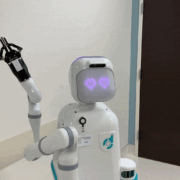


The homepage of Tangible Robotics, a cutting-edge AI-led humanoid robot startup, features a robot mopping up a spill, with a maroon absorbent towel in one hand and the coffee cup responsible for the spill in the other.
A simple task, really. But for us humans. A giant leap in technology for humanoid robotics. Cue Moravec’s Paradox, a theory from computer scientist Hans Moravec that posits that simple human tasks are complicated for machines.
A giant step, but possibly.
Most humanoid robots, including Eggie, still depend on human controllers. BBC reporter Joe Tidy came away impressed from the demos of Eggie and his (her? their?) ilk. Sort of. “This is the thing the promotional videos don’t show – and something that the Silicon Valley companies we visited are keen to downplay,” he says in his report.
But in Tidy’s report, Bipasha Sen, the founder of Tangible, is enthusiastic about the future of humanoid robots. Sen is quoted as saying, “Today people have two aspirations – a car and a house. In the future, they’ll have three aspirations – a car, a house, and a robot. “
The future of a chore-free life for the majority of the world’s women depends on how soon and if at all, robots like Eggie can learn the messy reality of home life. Studies show that women spend more time on domestic work than men. This is true for the United States, per a recent Gallup report. Also Europe. Per studies by the European Institute of Gender Equality. And this is true for the rest of the world and will continue to remain so. The United Nations predicts that by 2050, women globally will still be spending 2.3 more hours per day on domestic and unpaid care work than men.
So, how is Eggie’s training going so far?
“Our robots learn from real deployments – hundreds of unique environments and thousands of interactions. ‘In the wild’ data can’t be recreated in controlled setups; you can’t simulate the full range of human behavior,” says the Tangible website.
Overseeing these deployments and possibly, maybe turning the humanoid helper in the home a reality is MIT dropout Bipasha Sen. At MIT, while Sen was researching generative modeling and robotic manipulation, she realized the gap between research and real-world application was closing, and, as Sen’s co-founders gushed in this video, Sen skipped the Phd and jumped straight to the end goal.
Here you go! @tangiblerobots is putting robots to real use!!
— Bipasha Sen (@bipashasen31) February 6, 2025
Tangible is solving dexterity—this is a hard problem, WHICH IS WHY—Tangible is HIRING 🚨!! Tangible is making robots that can go into your cluttered sink, cluttered fridge, and get you the apple you wanted that was… https://t.co/h6JUXAuSFc
It will still be a while before we can order Eggie on Amazon. (Hope we don’t get a returned Eggie with dents and obviously re-packaged packaging that we’d be too lazy to return.) But AI is making dexterity, a formerly difficult skill for robots to master (a hardware issue), easier and faster with reinforcement learning.
“Humans can complete almost any object manipulation task you ask them to do — folding a piece of clothing, opening a gallon of milk, wiping up a spill with a cloth — even if it’s an object and/or task they’ve never encountered before. With robots, on the other hand, while it’s usually possible to automate any specific task (given the right hardware, enough time, and a narrow enough task definition), building a robot that can flexibly perform a variety of actions in a novel or highly variable environment is much harder,” says Engineer and Author Brian Potter in this informative post, Robot Dexterity Still Seems Hard.
Excited to be a part of ConceptGraphs — a unique representation of the 3D world highly amenable to robotics🤖👾!
— Bipasha Sen (@bipashasen31) September 29, 2023
Beyond capturing semantics of and between objects — ConceptGraphs is also integrated with powerful LLMs enabling highly complex queries! 🌍 pic.twitter.com/1SAWHEfRTk
Tangible AI is listed as an early-stage VC with 1 investor, possibly Ahead VC, a firm based out of the SF Bay Area and India. Source:
BBC gets this exactly right. It is impossible not to smile at Eggie 🙂 Eggie has come a long way in less than a year!
— Prateek Sharma // Ahead VC (@prateeks) January 19, 2026
Congrats to the @tangiblerobots for this coverage, first of many more to come. Excited to be on this journey with @bipashasen31 @benj_soria @shankaravaidy ! pic.twitter.com/Zqzk7GYImo